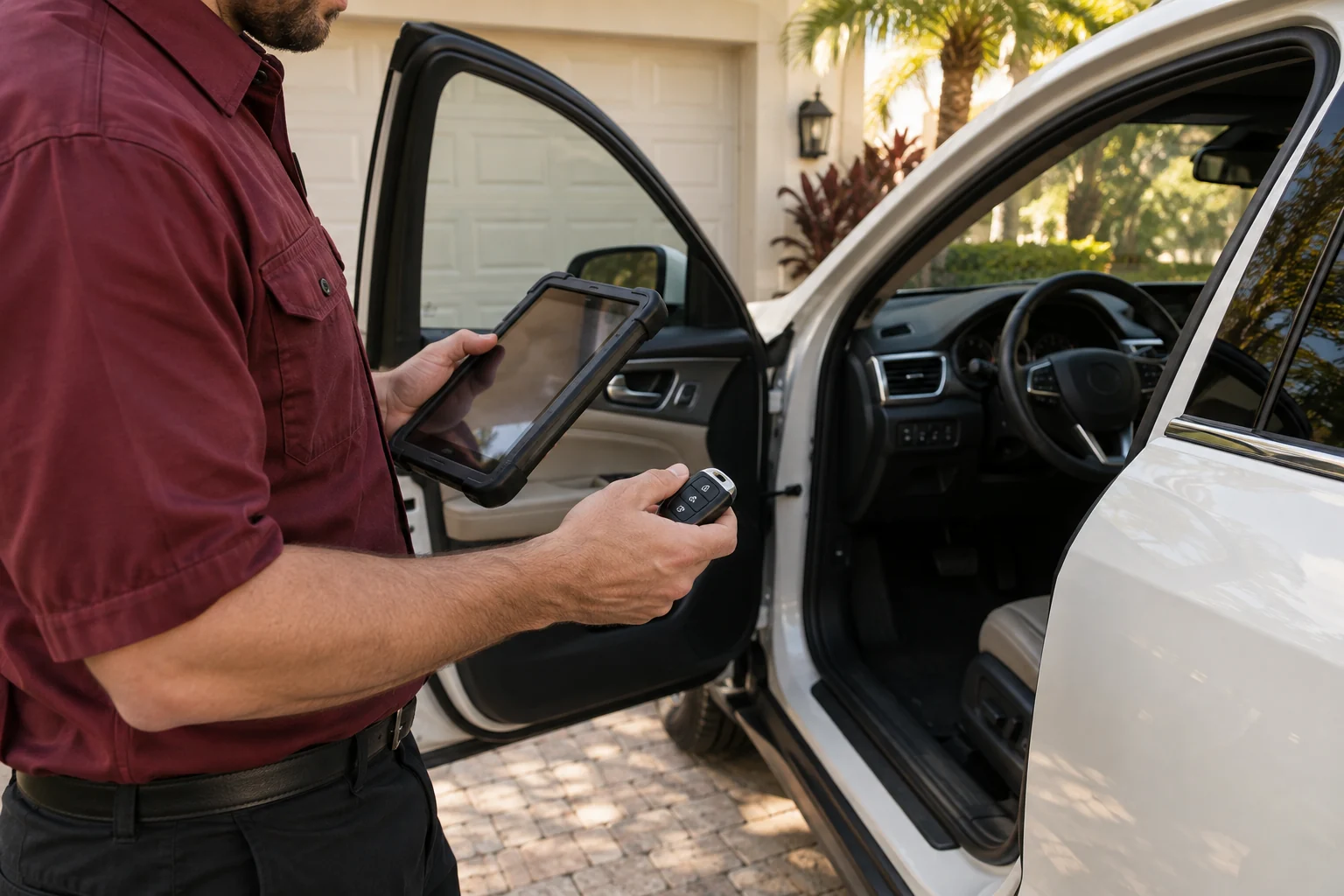
Automotive Locksmith in Pompano Beach
A car key today is part metal, part computer. This page is general guidance for Pompano Beach drivers who have lost a key, broken a fob, locked themselves out or run into ignition trouble, and want to understand the options.
Call (954) 888-8804Why car keys are not what they used to be
A few decades ago, a car key was a piece of cut brass that you could copy at any hardware counter in a minute. Today the typical key hides a small electronic chip inside its plastic head, and the car will not start unless that chip sends the right coded message. Some keys have no blade at all and are just a fob that stays in your pocket while you push a button on the dash.
This is good for security, because a thief cannot start the car with a simple copy. It is less good when you lose your only key, because replacing it involves cutting, programming or both, and the steps depend heavily on the make, the model and the year. A key that works on one vehicle may be useless on another that looks almost identical.
This page is general guidance for people in Pompano Beach. It does not describe local rules, and it does not claim any history with particular streets, lots or buildings. Its goal is to help you understand the situation before you pick up the phone.
Know the type of key you have
Most car keys fall into a few families. A plain metal key with no chip, found on older vehicles, is the simplest to replace. A transponder key looks like a normal key but carries a chip that must be recognized. A laser cut or high security key has a milled groove along the blade instead of the familiar jagged edge. A remote head key combines the blade with lock and unlock buttons. And a smart key or proximity fob works without ever touching the ignition.
Our article on transponder key programming explains what happens when a chip key is introduced to a car, and the one on laser cut versus standard car keys shows how to tell the types apart by sight.
If you are not sure what you own, take a clear photograph of the key, front and back, and keep it on your phone. When you describe the key on a call, the technician can often identify the type from the picture and plan accordingly.
Keep in mind that two keys that look the same can be different inside. A manufacturer may use the same outer shape across several years but change the chip or the programming between them. That is one reason a technician will ask for the year as well as the model, and why guessing from a picture alone is not enough to be sure that a key will work.
- Look at the blade: jagged edge or milled groove along the side.
- Look at the head: thick plastic usually means a chip is inside.
- Look for buttons: lock, unlock, trunk or panic suggest a remote.
- Check whether the car starts with a button instead of a key.
- Note the make, model and year, since most plans depend on them.
When the only key is gone
Losing the single key to a car is stressful, but it is a common problem with a clear path forward. A trained technician can create a new key for most vehicles by working from the car itself, using the vehicle identification number and proof of ownership. The new key then needs to be introduced to the car so it will start the engine.
You will be asked to show that the vehicle is yours. Expect to produce identification and a registration or title, because making a key for a car you do not own would be a serious problem. A genuine locksmith will insist on this, and you should be wary of anyone who does not.
If the car is parked somewhere inconvenient, say so on the call. The work may be done where the car sits or the car may need to be moved, and the technician can explain which makes sense. The work and the price are explained before it begins, including what will and will not be possible in your location.
There is also the question of how many keys you want. If you are making a new key anyway, making a second at the same visit is usually more straightforward than coming back later. Think about whether a family member shares the vehicle and whether a valet style key without trunk or glove box access would suit you for occasional use.
Push button start and smart keys
Push button systems have changed how people think about keys. The fob stays in your pocket or bag, the car senses it when you are close, and the engine starts with a button. When the fob battery weakens, the range shrinks, and you may find that the car sometimes refuses to start. Most vehicles have a backup way to read a weak fob, usually described in the owner manual.
If you lose a smart key altogether, a new one must be matched to the car, and that involves specialized equipment. Our article on what to do when a push to start key is lost explains the general steps, and the one on a key fob that is not working helps you tell a dead battery from a deeper fault.
Before you decide the fob is broken, try the simple things. Replace the battery with the correct type, hold the fob close to the start button as the manual describes, and check that no other electronic device is interfering. If these steps do not help, mention them when you call so the technician does not repeat them.
Some drivers worry that a dead fob battery means a locked car. Often the car can still be unlocked with a hidden mechanical key built into the fob, which is described in the owner manual. Locate it before you need it. If you are uncertain, take the manual or a photograph of the relevant page, and keep both somewhere easy to find.
Spares: worth it or not
Almost every person who has lost a car key wishes they had made a spare while they still had one. Duplicating an existing key is generally simpler than creating a new one from nothing, because the car already knows at least one working key. Many drivers wait until an emergency, and then face a bigger task at a worse moment.
Our short guide on whether a spare car key is worth it sets out the reasoning. In a coastal climate where keys get wet, baked in the sun and dropped in sand, a spare is not a luxury. It is a way to turn a lost key into an inconvenience instead of a crisis.
Keep the spare somewhere safe, away from the car, and not in a magnetic box under the bumper. Give it to a trusted person or leave it at home where you can reach it. Test it occasionally to make sure it still works, since batteries fade and buttons wear.
It is also worth deciding what kind of spare you want. A full spare with remote buttons is convenient but costs more to make than a basic spare that only starts the engine. Neither choice is wrong. Think about how you use the car, who else drives it, and how much inconvenience you would accept if the main key vanished.
Locksmith or the dealer
Many drivers assume the dealer is the only place that can make a key for their car. In reality, there are several routes, and the right one depends on the vehicle, the time you have and the circumstances. Some makes need the dealer for particular steps, while many others can be handled by a skilled mobile technician at the car itself.
The article on car key replacement, locksmith versus dealership weighs convenience, towing and flexibility without telling you which to pick. Call and describe the vehicle, and ask what is possible, rather than assuming.
A useful question is whether the car must be moved. If the key is lost and the car will not start, towing may be involved in one route and not in another. Understanding that before you choose can save a lot of effort.
Roadside coverage that came with your car, a credit card or an insurance policy might include help with lost keys. These benefits vary, so check your paperwork rather than assuming. If you have coverage, ask what it includes before booking, so you know whether to use it, and keep any receipts you may need to claim.
When the key goes in but will not turn
Ignition trouble is a different problem from a lost key. You may find that the key slides in, but the cylinder will not rotate. The steering may be locked against the wheel, the key may be worn, or the cylinder inside may be wearing out. Sometimes the key comes out with difficulty or not at all.
Do not force the key or strike the steering column. Forcing it can snap the key inside the ignition, which turns a repair into a larger one. Our guides on a key stuck in the ignition and ignition cylinder problems explain common causes, and the page on ignition repair covers how these are handled.
Describe exactly what happens: whether the key enters smoothly, whether the wheel moves, and what warning lights appear. These clues tell a technician whether the fault is the key, the cylinder or something else in the column.
Remember that the problem might not be mechanical at all. A battery that is nearly dead can mimic an ignition fault, because the dashboard lights are weak, the starter will not engage and nothing seems to respond. Mention how the dashboard and interior lights behave when you try the key, since it helps separate an electrical issue from a worn cylinder.
Locked out of your car
Car lockouts are a separate case. If the key is visible inside, or if you have a spare far away, the problem is getting into the car without harming the paint, seals or electronics. Modern doors contain wiring and side airbags, so amateur attempts can cause damage that costs more than the call you were trying to avoid.
Our page for lockout service in Pompano Beach explains the steps in general terms, and the article on keys locked in the trunk addresses a surprisingly common version of the problem.
If a child or a pet is inside, particularly in a hot car, treat it as urgent and call emergency services first. In South Florida's sun, a closed vehicle heats up with alarming speed, and help from emergency responders is the right first step.
Wear, weather and warning signs
Cars parked outdoors live a hard life. Sun fades and cracks plastic, salt air corrodes contacts, and heat shortens battery life. A key that works perfectly today may slowly stop working, and the warning signs are usually there: buttons that need a harder press, a car that sometimes ignores the fob, or a blade that has worn smooth.
Pay attention to these signals and act before the key fails. Replace fob batteries on a regular basis, avoid carrying a heavy bunch of keys on the ignition key, since the weight wears the cylinder, and keep the keyway clear of lint and debris.
If your ignition key feels rough, do not wait. A worn key can damage the cylinder, and a damaged cylinder can wear the key further. The sooner the pair is checked, the smaller the repair tends to be.
Humidity also invites moisture into fobs. If your fob has been dropped in water or left on a wet beach towel, dry it thoroughly and avoid pressing buttons until it is dry. Rice in a bag is a popular tip, but time and air matter more. A fob that has dried well often recovers, and one that has not may need to be replaced.
Other vehicles and the motorcycle question
Not everything on the road is a sedan. Pickups, vans, work trucks, boats on trailers and motorcycles all rely on keys that may be different from a standard car key. Some have simple mechanical locks, others use chips, and a few combine several locks, such as a separate key for a toolbox, a cargo door and a fuel cap.
Motorcycle keys can be especially tricky because the ignition is small and exposed to weather. The article on motorcycle key replacement explains what to expect. For work vehicles, think about whether several drivers share keys, and whether it is time to cut a controlled set instead of passing around the last remaining copy.
When you call, mention the exact type of vehicle, because the plan and the equipment depend on it. A clear description at the start saves time at the roadside.
How to prepare for the call
Before you call, gather what you can. Know the make, model and year, your location, whether you have any working key, and whether the car is currently locked, running or stranded. Have your identification and proof of ownership nearby, even if only as photographs.
If you are stranded at night, in a parking lot or on the roadside, tell the technician exactly where you are and whether you feel safe. Stay inside a lit area, near people if possible, and keep your phone charged. Your safety matters more than the car, and a calm description of your surroundings helps the right plan be made.
The process is simple: you call and describe the situation and place, the work and the price are explained before it begins, and the finished work is tested with you. You should see the new key start the car, lock and unlock the doors, and operate any buttons it should.
For wider background, see the Pompano Beach locksmith overview and the main car key replacement page. Both fill in the details that apply to every vehicle.
If you want a second opinion on how a job is described to you, ask for the plan in plain words and compare it with what you have read here. Honest technicians welcome questions, and the more you understand about your key, the easier it is to judge what you are told and decide what is right for you.
Common questions
Can a locksmith make a car key if I have lost all of them?
For many vehicles, yes. A new key can be created from information about the car, and then matched to it so the engine will start. You will need to show identification and proof that the car is yours. Describe the make, model and year on the call, and the plan is explained before work begins.
Why does my fob work only sometimes?
A weak battery is the most common reason, followed by worn buttons and interference. Replace the battery with the correct type first. If the problem continues, the fob may need repair or replacement. Mention what you have already tried when you call, so nothing is repeated unnecessarily.
Is a spare key really worth having?
Most drivers who have lost their only key say yes. Copying a key that already works is generally simpler than starting from nothing. A spare also helps if a fob breaks or a key goes missing. Store it away from the car and test it from time to time.
What should I do if the key will not turn in the ignition?
Stop and do not force it. Check whether the steering wheel is locked against the key, and try turning the wheel gently while turning the key. If it still will not move, call and describe the symptoms. Forcing it risks snapping the key or damaging the cylinder.
Do I need to take the car to a dealer for a new key?
Not always. Some vehicles need particular steps that only certain providers can perform, while many can be handled at the car by a mobile technician. Describe the vehicle and ask what is possible. The options, including whether the car must be moved, are explained before the work begins.
Does this page describe rules for vehicles in Pompano Beach?
No. It is general guidance and does not state local rules or describe any specific location or past job. Requirements for proving ownership can vary, so ask the agency that handles your vehicle records or your lender about anything specific, and have identification ready when you call.
Talk through the job before work begins
Explain the problem, what has to work again and who needs access afterward. We talk through the scope and the price first, and work begins after you agree.
Call (954) 888-8804