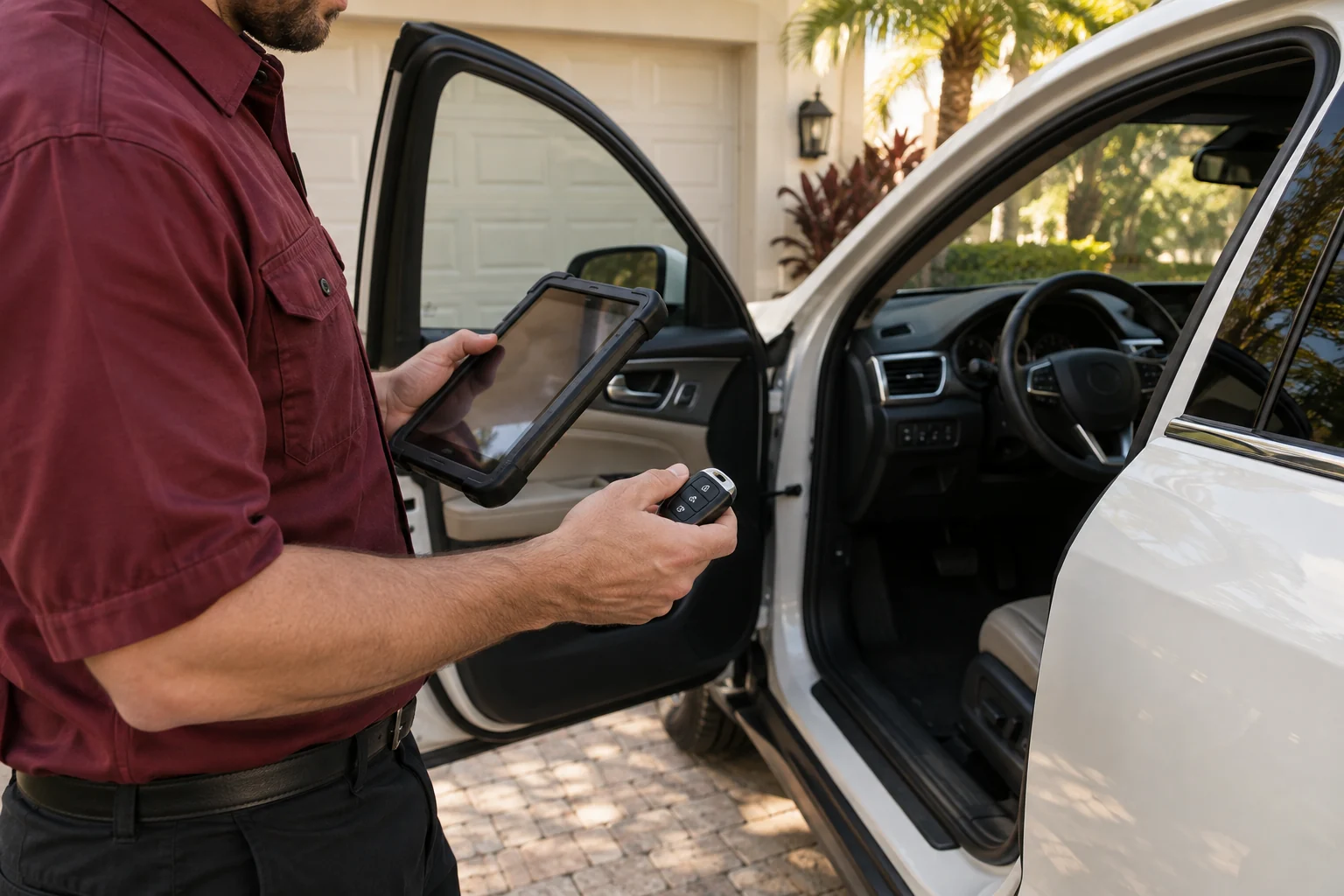
Rekey Service in Weston
Rekeying changes which key opens a lock without replacing the lock itself. This page is general guidance for people in Weston who want to understand the process, the decisions involved, and what to expect from a visit.
Call (954) 888-8804What rekeying actually changes inside a lock
Most residential locks in Weston, like locks everywhere in Florida, are pin tumbler cylinders. Inside the cylinder sits a column of small brass pins of different lengths, each pushed down by a spring. When the correct key slides in, its cuts raise every pin to exactly the height where the split between pins lines up with the edge of the rotating plug. That line is called the shear line, and once everything lines up, the plug can turn and the bolt can move.
Rekeying means taking the pins out and replacing them with a different set sized to a new key. The lock body, the faceplate, the deadbolt, and the handle all stay where they are. Only the internal combination changes. The old key still slides into the keyway, but because the pins no longer match its cuts, it will not turn.
That is why rekeying is often described as changing the lock without changing the lock. For a homeowner it means the existing hardware you already like and already paid for keeps working, while every old copy of the key in a drawer, a former tenant's pocket, or a contractor's truck becomes a piece of metal that opens nothing.
This page is general guidance for people in Weston and does not describe any particular neighborhood or building. The principles are the same whether the door is on a single family house, a townhome, or a condo unit.
Situations where a rekey is the sensible move
The most common trigger is a change of hands. You close on a house, take over a rental, or move into a unit, and you have no way of knowing how many keys exist. Previous owners hand copies to relatives, cleaners, pet sitters, and neighbors, and almost nobody keeps a list. A rekey resets that count to the keys you are holding right now. The guide on rekeying locks after moving walks through that first week in more detail.
Another trigger is a lost or stolen key. If a key ring disappears and it carried anything that identified the address, a rekey closes the question permanently. You do not have to decide whether the keys were truly taken, because the old ones simply stop working. If you are weighing that choice, lost house keys: rekey or replace lays out the reasoning.
Life events matter too. A separation, a roommate leaving, a contractor finishing a long renovation, a caregiver whose schedule has ended, or an adult child who has moved out are all moments when it is reasonable to say that the group of people holding keys should match the group of people who live there.
Finally, some owners rekey simply for convenience. Having a front door, a back door, and a garage entry door all open with one key instead of a bulky ring is a daily improvement, and it is a standard thing a locksmith can arrange.
- You bought or moved into a home and do not know who holds copies.
- A key was lost, stolen, or kept by someone who no longer should have access.
- A tenant, roommate, or worker has left and the key was not returned.
- You want several doors to open with one key.
- The locks are in good shape but the key control is not.
What happens during a visit, step by step
Rekeying begins with a phone call. You describe what you have, such as how many doors, whether they are deadbolts or knobs, and whether anything is stuck or damaged. The work and the price are explained before it begins, so you know what is being done and why. Nothing should start until you understand and agree.
On site, the technician inspects each lock to confirm it can be rekeyed. Most standard cylinders can, but a lock that is badly worn, corroded, or broken may not hold a new combination reliably. Humid coastal air shortens the life of some finishes and internal parts, and an honest inspection looks for that before committing to a rekey.
Next the cylinder is removed from the lock, the old pins are replaced with pins sized for the new key, and the cylinder is reassembled and put back on the door. The process is repeated door by door. If you want several locks on one key, they are pinned to the same cut pattern so a single key works across them.
The finished work is tested with you. You turn the new key in every lock, throw each bolt, and confirm that the old key no longer turns. If something feels stiff or misaligned, that is the moment to say so. A lock that works smoothly in the hand is a lock that was put back together properly.
Rekey or replace: how to decide
Rekeying and replacing both solve the problem of unknown keys, but they are different tools. If your locks are sturdy, in good cosmetic condition, and fit the door properly, rekeying keeps them in service. It is usually the more economical path because it avoids buying new hardware, though the actual cost depends on the number of locks and the type, so ask for an explanation before work starts. The article on rekeying versus replacing locks compares the two side by side.
Replacement makes sense when the hardware itself is the weak point. A deadbolt that turns loosely in the door, a knob with a wobbling handle, a lock with a damaged faceplate, or a finish that has pitted from salt air will not get better with new pins. Neither will a lock whose bolt is too short to engage the strike properly. In those cases new hardware is a better use of money, and you can choose a stronger grade at the same time. The note on deadbolt grades explains what the grade labels mean.
There is also a middle path. Some owners rekey the locks they like and replace only the one or two that are failing. Others use a rekey as the first step and plan a gradual upgrade over time. Neither choice is wrong, and a good technician will lay out the options without pressure.
If you are still unsure, describe the doors on the phone. Mentioning the age of the hardware, whether it sticks, and whether the door closes cleanly gives enough information to talk through which route fits.
Condos, townhomes, and shared buildings
Many Weston residents live in communities with shared governance, and that adds a layer to the decision. Some associations have rules about what locks can be installed on exterior doors, who must hold a copy of the key, or whether a unit's entry hardware must match a standard. Those rules differ from one community to the next, so the only reliable answer comes from your association or management office. Check before you change anything on a door that faces a shared hallway or the common exterior.
Rekeying is often the friendlier choice in these settings, because the outward look of the hardware does not change. The same handle, the same finish, and the same size remain, so there is usually less to question. Even so, if your community requires a spare key on file, make sure the new key is delivered to the right party.
Landlords and property managers face a related but different situation. Between tenants, rekeying is a routine reset. The articles on rekeying rental property and turnover rekeying for property managers cover how to keep it organized when you manage more than one door.
Whatever the building, keep a short written record of how many keys were cut and who received each one. It takes a minute and removes a lot of guesswork later.
Rekeying the doors people forget
When people say they want their house rekeyed, they usually picture the front door. But a thorough job considers every way in. The back door, the side door, the door from the garage into the house, a patio slider with a keyed latch, and a detached shed or storage room all count. If one of those still opens with an old key, the effort on the front door has bought less than you think.
The garage entry door deserves special attention because it is easy to overlook and often sits in a shadowed part of the property. The guide on garage entry door security explains why. Remember too that a garage door opener and its remote are a separate system from the keyed locks. This page covers only the keyed locks.
Sliding glass doors have their own hardware, and many of them use a latch rather than a pin tumbler cylinder you can rekey in the usual way. If your slider has a key, mention it when you call so it can be assessed. For general thinking about these doors, see sliding glass door locks.
Mailbox locks, file cabinets, and interior office doors can also be included. They rarely matter for break ins, but they matter for privacy, and bringing them into the same key system saves you carrying extra keys.
Keyed alike, and keeping spares sensible
If you want one key for several doors, the term for that is keyed alike. Each cylinder is pinned to the same combination, so one key operates all of them. This is convenient, but it also concentrates risk: lose that one key and every keyed alike door is affected. Weigh the convenience against how you actually live. A family that moves through the front and garage doors daily may value one key, while a household with a rental room or an outbuilding may prefer to keep that one separate.
Spares deserve thought as well. A key hidden under a planter or inside a fake rock is the first place anyone looks. The piece on sensible ways to hide a spare key offers better options, and the one on where and how to copy keys covers making copies carefully.
One small habit helps a lot: after a rekey, collect the new keys in a count. If you were given three, confirm three are in hand. Cutting additional copies is simple, but each one is another key that exists, so make them deliberately.
Some keys are restricted, meaning copies can only be made with authorization. If that interests you for a business or a larger household, read about restricted and high security keys.
South Florida conditions that affect locks
Locks here work in a harder environment than in many other places. Salt air and constant humidity attack metal finishes, and over time they can leave the inside of a cylinder gritty or sticky. If a key has started to feel rough going in, or you have to jiggle it, that is a sign the lock is aging and worth mentioning during a visit.
Hurricane season adds a different pressure. Before a storm, homeowners often secure shutters and move valuables, and afterward they sometimes find doors that no longer close cleanly because frames shifted or swelled. A lock that fought you before the storm may fail after it. Checking the hardware ahead of the season is calmer than doing it with weather approaching.
Older homes and newer ones differ too. Older doors may have worn frames, loose strike plates, or locks that have been replaced piecemeal over time. Newer construction may use lighter hardware that looks sleek but offers less resistance. Neither is a reason to panic, but both are reasons to look at the whole door and not just the cylinder.
If your door has a lock that was never very strong to begin with, a rekey makes the key situation correct but does not strengthen the door. A reinforced strike plate is a separate, worthwhile improvement, discussed in stopping door kick ins with a strike plate upgrade.
How rekeying fits with other lock work
Rekeying is one piece of a broader set of home lock services, and it often goes together with something else. If you are changing locks because of a break in, the sequence in after a break in: a recovery checklist helps you decide what to do first. If you plan to add electronic locks, you can learn about smart lock options and how they relate to keyed backups.
You may also have a lockout in mind that led you here. When you are locked out of the house, rekeying is not the immediate task. Getting back in is. After that, you can decide whether the incident showed a weakness worth fixing. The overview of house lockouts and rekeying ties the two together.
Neighboring areas follow the same principles. If you work or own property just across a boundary, general guidance for rekeying in Davie or rekeying in Miramar reads much the same, while the details of your own building still decide the answer.
Whichever route you choose, a clear explanation up front matters more than anything. Ask what will be done to each lock, what it will take, and what you will have in your hand at the end.
Getting ready for the call
A few minutes of preparation makes the conversation easier. Walk around and count the locks you want to address: front door knob and deadbolt, back door, garage entry, side doors, and any specialty locks. Note whether each is a knob, a lever, or a deadbolt, and whether any of them are stiff or loose. Mention anything that is already damaged.
Think about how many keys you want at the end, and who should hold them. Decide whether you want some doors keyed alike. If you are a tenant, confirm with your landlord or property manager that rekeying is allowed, because many leases require permission. If you are in an association, check its rules.
Make sure you can show you are entitled to have the work done, since a reputable locksmith will want to be confident the person asking actually lives at or controls the property. This is a normal protection, not an inconvenience.
Write down any questions in advance, such as whether a particular door can share a key with another, or whether an old lock is worth keeping. Questions are easier to remember at the kitchen table than with a technician waiting. Finally, have the existing keys ready. A technician can sometimes work with one key to confirm everything operates properly, and handing over all you have helps verify that the old combination is truly retired once the job is finished.
Common questions
Does rekeying make my locks more secure?
Rekeying controls who has access by retiring every old key. It does not make the hardware itself stronger. If your lock is sturdy and fits the door, that is enough for many homes. If the lock is worn or weak, replacing it, or adding a stronger strike plate, improves resistance in a way rekeying cannot.
Will the old key still fit into the lock after rekeying?
It may still slide into the keyway if the key blank is the same type, but it will no longer turn the cylinder. The internal pins now match a different cut pattern. This is why you test the old key at the end of the visit to confirm it fails.
Can every lock be rekeyed?
Most standard residential pin tumbler locks can. Locks that are badly corroded, damaged, or built in a nonstandard way may not hold up to rekeying and are better replaced. A technician looks at each lock first and tells you honestly which route makes sense.
Can I rekey just one door and leave the rest?
Yes, you can address a single door. Many people prefer to do all exterior doors together so everything matches one key and no old copy still works anywhere. That choice depends on your situation, and it is reasonable to start with the most important door.
Should I rekey if I have a smart lock?
Smart locks add digital codes, but most still have a mechanical key backup. If that backup key has been shared, rekeying the cylinder is sensible, and changing digital codes is also wise. Some models have a keyway you can rekey, others do not, so describe the model when you call.
What do I need to bring to the visit?
Have the existing keys on hand, know which doors need work, and be ready to confirm you live at or control the property. If you rent, have your landlord's permission. Being at the home during the work lets you test every lock with the new key before the technician leaves, and ask any question while the door is still open in front of you.
Talk through the job before work begins
Start by describing the situation, the lock or key involved and who must have access. You hear the price and the plan before anything is done.
Call (954) 888-8804