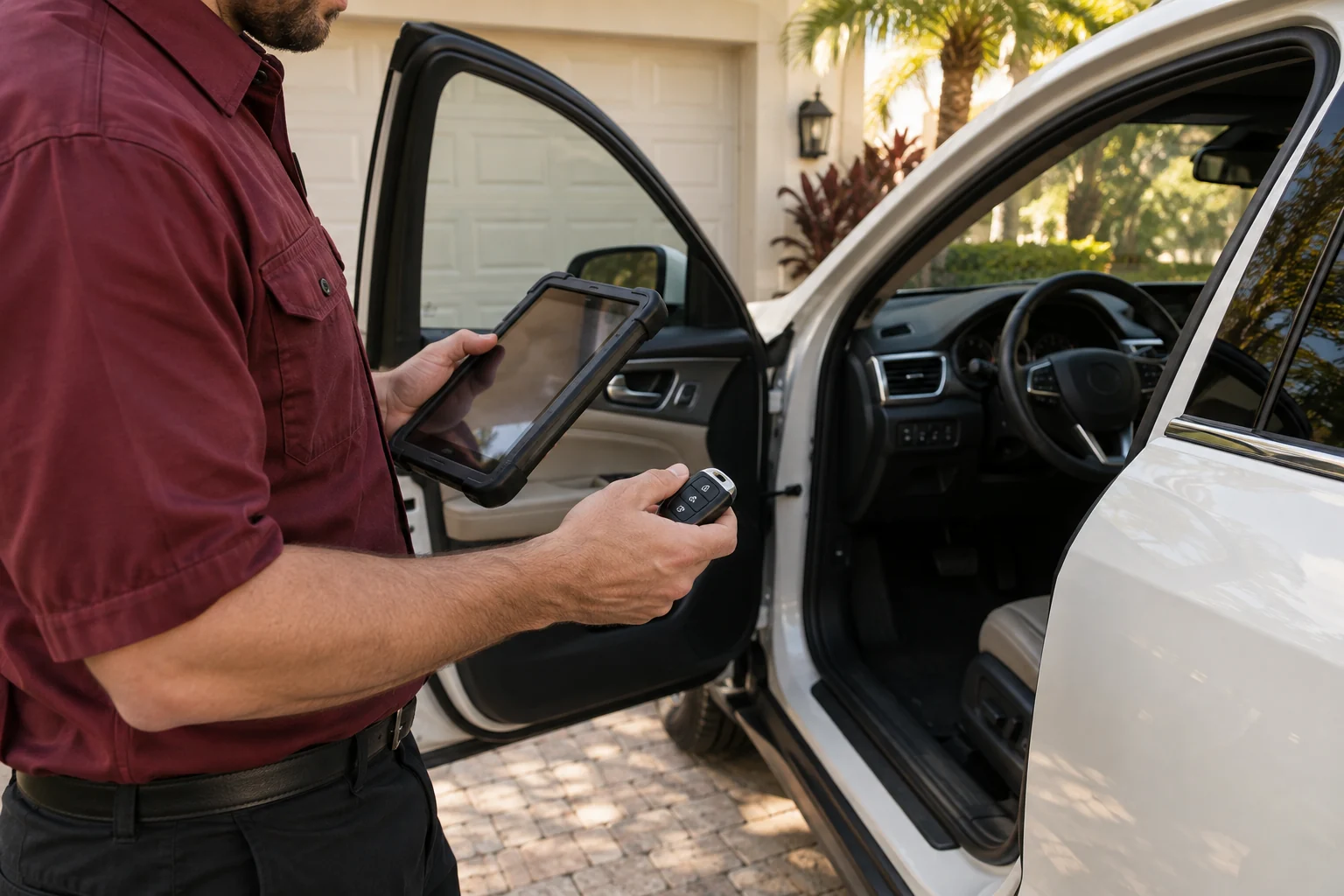
Rekey Service in Miramar
Rekeying makes old keys useless without replacing your hardware. This guide explains when Miramar homeowners, landlords and business owners should do it, how the process works and what to expect when it is finished.
Call (954) 888-8804What rekeying actually is
Inside a standard door lock is a cylinder holding a row of small spring loaded pins of different lengths. The right key lifts every pin to exactly the correct height, which lets the cylinder turn. Rekeying means taking the cylinder apart and replacing the pins with a new set that matches a different key. The lock stays on the door, the finish stays the same, and the old key stops working.
The result is simple to describe. You keep the same locks but hold new keys, and anyone with an old key finds that it slides in but will not turn. For most people that is exactly what they wanted, which is control over who can get in, without paying for new hardware at every door.
This page is general guidance for properties in Miramar and the surrounding area. It does not describe particular neighborhoods or claim local history. It simply explains the work in plain language so you can decide with confidence whether it fits your situation.
One thing worth knowing at the start is that rekeying is a bounded job. It does not repair a sagging door, replace a broken latch or fix a loose handle. Those are separate problems, and a technician will tell you honestly if the lock needs more than new pins. Keeping the scope clear helps you judge whether the work was done properly.
Good reasons to rekey
The most common reason is moving into a home you did not build. Previous owners, tenants, agents, contractors and cleaners may all have had keys over time, and you have no way to know how many copies exist. Changing the key is a cleaner start than trusting the past.
Lost or stolen keys are another obvious trigger, especially when the key could be tied to your address. A wallet taken from a car, a purse left in a restaurant or a key ring dropped at the beach can all justify a rekey, even if nothing has happened yet.
Life changes count too: a separation, a roommate who moved out, a former employee, a babysitter or a contractor who finished a job. You may trust everyone involved, but control over keys is a matter of logistics, not accusation. Most people who rekey are not afraid of anyone in particular. They simply prefer to know exactly where every working key is. Our article on rekeying locks after moving walks through a typical new home checklist.
If you bought a home from a builder or after a renovation, there may be even more keys in circulation. Workers, inspectors, appraisers and agents often use lock boxes and spare sets, and a lock box code can be shared widely. Changing the cylinders gives you a clean starting point whatever the history of the house.
How the work goes, step by step
The technician starts by identifying each lock: brand, keyway, and whether it is a knob, lever or deadbolt. Then each cylinder is removed from the door, opened, and fitted with new pins that match a new key. The cylinder goes back in, the lock is tested with the new key and the old key is tried to confirm that it no longer works. If any lock turns out to be too worn to rekey well, the technician should say so on the spot instead of leaving you with a lock that sticks.
Because several locks can be set to the same new key, you might end up with one key for the front door, the back door and the garage entry. That is called keying alike, and it is a convenience many homeowners prefer. Others like separate keys for different doors, such as a different one for a pool gate or a storage room. Tell the technician your preference in advance, because it affects how the pins are arranged and how many keys are cut.
The work takes place at your home, and you are present for the testing. The work and the price are explained before it begins, and the finished work is tested with you. For a look inside the process, read how rekeying a lock works, and see the service overview for house lockout and rekey work.
A point that surprises some people is that the number of locks does not change the idea. Whether it is two doors or a dozen, each cylinder gets the same treatment. Expect the visit to be longer with more locks, and mention extras like a garage entry, side gate or storage room up front so nothing is forgotten.
Rekey or replace?
This is the question most people ask. Rekeying keeps your existing hardware and changes only the key. Replacing swaps the whole lock for a new one. Neither is better in every case, and the right answer depends on the condition of what you have and what you want to achieve.
Rekey when the locks are in decent shape, operate smoothly and match the look you like. Replace when a lock is corroded, loose, worn, broken, a poor grade for the door or simply not what you want any more. In coastal air, finishes may peel and internal parts may corrode, and a technician can show you what they see. Ask to hold the worn part in your hand. Seeing pitting, wear or a bent spring makes the recommendation concrete, and it lets you decide for yourself instead of relying on a general statement.
If you are weighing a smart lock, a keypad or a stronger deadbolt, replacement is the natural time to upgrade. The article on rekeying versus replacing locks sets out the decision with examples, and the rekey cost guide explains which factors influence what you are quoted.
A useful middle path exists when only some locks are worn. You can replace the weakest ones, such as an exterior deadbolt, and rekey the rest to match, so one key still opens everything. A technician can set that up in a single visit, and the result is a mix of new and existing hardware that works as one system.
How often should a home be rekeyed?
There is no universal schedule. A reasonable rule is to rekey when something changes: you move in, someone who had a key leaves your life, a key goes missing, or you have a gap in your records about who holds copies. If none of that has happened and you trust your key list, there is no need to do it on a calendar.
Some families like to rekey at big transitions such as a divorce, the end of a long term renter, or after a child leaves home. Others do it after a contractor project that spanned weeks with a key left on site. The point is not frequency but control. If you can answer the question of who has a working key to your door, you are in good shape. If you cannot, that uncertainty alone is a reason to act.
Think about how many copies exist, too. A key that has been duplicated at a hardware counter several times is harder to track than one that has never left your hands. The guide on how often to rekey a home discusses these triggers in more detail.
Rentals and property managers
Landlords face the same question every time a tenant leaves. The previous occupant may have made copies, given them to friends or never returned the keys. Rekeying between tenants removes that uncertainty and lets the new occupant begin with keys only they and the owner hold.
It also keeps liability simple. If something goes wrong in a unit, it helps to know when the keys were last changed and who received them. A short written record of each rekey, with the date and the number of keys issued, is a useful habit.
If you manage several units, consider a system. Standardizing on one lock brand or keyway can make the work simpler, and some managers choose a master key arrangement. See the notes on rekeying rental properties and rekeying between tenants for planning ideas.
Before any tenant changeover, take a moment to check the condition of each lock. A lock that sticks or a deadbolt that does not extend fully will cause complaints later. Bundling a small lock repair with the rekey saves a second visit and shows the new occupant that the unit was prepared with care.
Offices, shops and shared spaces
Business owners should treat key control as an ongoing task. Staff turnover, vendors, cleaners and seasonal workers all create copies that nobody tracks. A rekey after an employee departs is a standard security step, and it usually costs far less than the trouble it prevents.
Think about which doors matter most. The front entrance, the stockroom, the office with records or cash and any door to a server or utility room are priorities. Less sensitive doors can be handled on a slower schedule.
Where many people need access, a master key plan can keep things organized. For ideas on setting that up, read about rekeying an office after an employee leaves and how keyed alike and master key options differ.
Do not overlook the small locks: filing cabinets, supply closets, back gates and mailboxes. They are often keyed to ancient sets that nobody tracks. Including them in the rekey gives you a tidy key plan and removes a surprising number of loose ends in one visit.
Lost keys: whether to rekey right away
When you lose a house key, the first question is whether anyone could connect it to your address. A key lost at home, in the couch, is a different risk from one lost at a crowded public place. If there is no name or address on it, the risk may be low, but you do not know who found it.
If the loss happened in a place where someone could try it, rekeying is the cautious answer. It is also the simplest, because it does not disturb the door or the frame. In the meantime, make sure the door is locked with another method, such as a deadbolt you still have a key for. If both locks used the same lost key, think about a temporary measure like a door security bar from the inside until the work can be done.
You also need a replacement plan. Cut spare keys only from keys you trust, and keep them where you can find them. The article on lost house keys and whether to rekey or replace offers a calm way to think it through.
Copies, spares and who should hold them
After a rekey, you need to decide how many keys to have and who gets them. Keep it small. Each additional copy is another thing to lose, and each person who holds one is a link in your security. A typical household may want one key per adult and a spare stored safely.
Be careful about where copies get made. Hardware counters can duplicate ordinary keys in minutes, which is convenient but means that a key can be copied without your knowledge. Some systems use restricted keyways that cannot be copied without authorization, which suits businesses and landlords who need control.
Write down who has what. A simple note listing the holders and the date of the last rekey is enough. The guide to where and how to make duplicate keys explains your options for making copies without losing control.
Label keys in a way that does not reveal your address. A tag reading front door or garage is enough, and a tag with a street name defeats the purpose if the ring is ever lost. Store spares somewhere cool and dry, because heat and humidity can corrode keys left in a car or a garage drawer.
Climate, wear and sticky locks
In Florida, locks work in difficult conditions. Humidity, salt in the air and heat cause corrosion and swelling, and a rekey is a good time to see how a lock is aging. If the cylinder feels gritty or the key turns stiffly, the lock may be near the end of its useful life.
A technician who takes a cylinder apart sees its condition directly. They can tell you if pins are worn, springs are weak or parts are corroded, and whether a rekey will give a smooth result or a replacement would serve you better. After a hurricane season with heavy rain, this is an especially good time to look, since water exposure leaves its marks on exterior hardware.
If a lock sticks only in rainy weather, the problem could be the door, not the lock. A door that has swollen will bind the bolt. A good locksmith checks the whole assembly, not just the cylinder, so you do not pay for a rekey that fails to fix a symptom caused elsewhere.
Getting ready and what you should see at the end
Contact with Half Off Locksmith is by phone. Tell the person how many locks you want rekeyed, what types they are and whether you want them keyed alike. Mention whether you rent, since permission might be required, and say if any lock is a brand you recognize or has been replaced recently. Have all existing keys ready, because they help the technician match locks.
Decide beforehand how many new keys you need and who will hold them. If you are unsure, say so, and ask for suggestions. Think about bringing together the mailbox, side gate, shed and any other lock you want included, so one visit handles everything.
At the end, test every lock yourself. Use the new key in each, confirm the old key fails, and check that deadbolts and latches move smoothly. Keep the new keys safe, and write down the date for your records. If something feels stiff or uneven, say so before the technician leaves, because small adjustments are easiest while everything is still in front of you. A calm last walk through every door is the simplest quality check there is, and it takes only a few minutes. For nearby areas, the page for Pembroke Pines covers the same service.
Common questions
Will my old keys still work after a rekey?
No. Rekeying changes the pins inside each cylinder so only the new key turns it. The technician should try an old key in your presence to confirm it no longer works. Your existing hardware stays on the door, and only the internal key pattern changes.
Can all my locks use the same key?
Often yes, if the locks are compatible. This is called keying alike, and it lets one key open the front, back and garage entry doors. Some people prefer separate keys for different doors, and a locksmith can set either arrangement.
Is rekeying better than replacing the locks?
It depends on the condition of the locks. Rekeying is a good choice when the hardware is sound and you only need new keys. Replacement suits locks that are worn, corroded or no longer fit your needs. A technician can show you what shape yours are in.
When is a good time to rekey?
After moving into a home, after losing keys, after a tenant, roommate or employee leaves, or after a contractor held a key for a long project. There is no fixed schedule. The trigger is any change that leaves you unsure who may hold a copy.
Do I need to be home for a rekey?
Generally you or an authorized person should be present to confirm the work, receive the new keys and test the locks. Arrange who will be there when you call, and mention any gates, building rules or pets that could affect access to the doors.
Can a rented home or condo be rekeyed?
Often, but you should check your lease or association rules first. Landlords and managers may require a spare key or prior approval. Requirements vary, so ask in writing before arranging the work, and keep a record of any permission you receive.
Talk through the job before work begins
Tell us what happened, which doors or keys are involved and who needs to get in. The price and the plan are agreed with you before any work starts.
Call (954) 888-8804