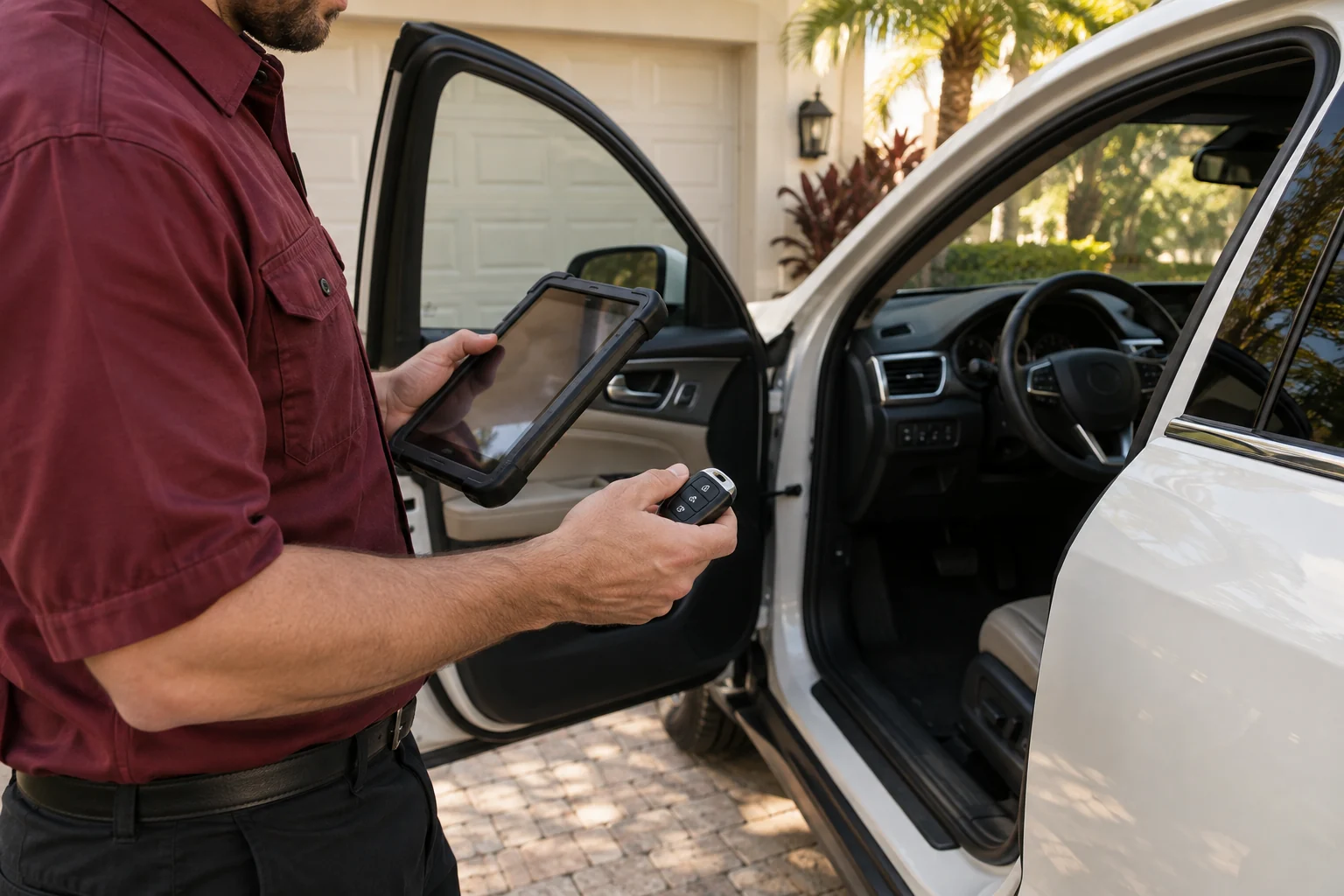
Rekey Service in Pompano Beach
Rekeying changes which key operates a lock without replacing the lock itself. This page is general guidance for Pompano Beach homes, condos, rentals and small businesses that want to know who holds a working key.
Call (954) 888-8804What rekeying actually changes
Inside most door locks is a cylinder with a row of small pins of different lengths. When the right key is inserted, its cuts raise each pin to exactly the right height, and the cylinder can turn. Rekeying means taking the cylinder apart, swapping those pins for a new set, and cutting a new key to match. The old key still goes into the keyway, but it no longer lifts the pins correctly, so it will not turn.
The result is a lock that looks the same but answers to a different key. You keep the handle, the deadbolt and the finish you already chose. Only the internal arrangement has changed. That is why rekeying is often the sensible answer when the hardware is in good shape and the real concern is who might be holding a copy of the old key.
This page is general guidance for people in Pompano Beach, and it does not describe any local rule or claim that work has been done in a particular building. Its purpose is to help you decide whether rekeying fits your situation and what to ask before you agree to any work.
One more point is worth making early. Rekeying does not make a door stronger against force. It controls who can open the lock with a key, which is a different question from how well the door and frame resist a kick or a pry. If your worry is a weak frame or a short strike plate screw, that is a separate repair, and a good technician will tell you so instead of letting you assume that a rekey fixed everything.
Signs that it is time to rekey
The most common reason is simple uncertainty. You moved into a place and have no idea how many keys exist. A previous tenant, a contractor, a cleaner, a relative or a former partner may all have had a copy at some point. If you cannot account for every key, a lock that still answers to all of them gives you only the appearance of security.
Another trigger is loss. A missing key is a different problem from a key left on a kitchen counter, because a lost key might be anywhere. If it was on a ring with an address or a car fob, the risk increases. The article on lost house keys and whether to rekey or replace goes through that decision step by step.
A third trigger is a change in who should have access. A separation, a roommate moving out, an employee leaving or a rental turning over are all moments when the old key should stop working. You do not need a crisis for this. Treating a change in the household as a reason to refresh the lock is ordinary good practice, and it is far less disruptive than waiting for a problem to prove the point.
- You moved in and cannot account for every key that exists.
- A key was lost, stolen or taken by someone who no longer should have access.
- A roommate, employee, contractor or tenant has left.
- You want several doors to open with one key instead of a heavy ring.
- The locks are in good condition and you only want the keys changed.
Rekeying compared with replacing
Rekeying and replacing are two different tools, and the right one depends on the condition of the hardware. If the lock turns smoothly, the finish is sound and the deadbolt is solid, rekeying gives you new security at a modest scale. If the lock is worn, loose, corroded or simply a weak grade of hardware, new keys inside a poor lock do not fix the underlying issue.
Salt air matters here. Along the coast, metal finishes and internal parts can corrode, especially on doors facing the weather. A lock that feels gritty or stiff might be a candidate for replacement rather than rekeying, because the problem is the mechanism and not just the key. The guide on rekey versus replace sets out how to tell the difference.
There are also times when replacement is chosen for style or function, not condition. You might want a keypad, a smart lock or a heavier deadbolt. In those cases, rekeying is not the goal. If upgrading interests you, look at the page on smart locks to see what the options look like before you decide.
How the visit usually goes
The process is straightforward. You call and describe the situation and the place, including how many locks are involved and what kind of doors they are. The work and the price are explained before it begins, so there is nothing to guess about. During the visit, each lock is removed or opened, the pins are changed, and the new key is cut and tried.
A careful technician tests each lock several times with the new key and confirms that the old key no longer turns. That test should happen with you present, because it is the proof that the work achieved what you wanted. Ask to see the old key fail. It takes a few seconds and it removes any doubt.
If you want several doors to share one key, say so at the start. Keyed alike setups are common, and they save you from carrying a bundle of keys. It helps to know that doors from different manufacturers or of different types may not combine easily, so mention what you have. A good technician will tell you plainly what can and cannot be matched.
Houses, condos and rentals each need a slightly different plan
A single family home is the simplest case. You control every door, and you can decide how many to rekey and which to leave alone. Many owners rekey the front door, the back door and the garage entry first, since those are the doors most likely to have been used by others. Our article on rekeying locks after moving in covers a sensible order of work.
Condos and apartments add layers. The entry door lock may be your responsibility, but a building might have rules about hardware, and shared access points are often controlled by an association or a management office. Requirements differ, so ask your association or property manager what applies before you change anything. Do not assume that what worked in another building will be allowed in yours.
Rental properties turn over frequently, and each turnover is a natural moment to rekey. Landlords and managers will find the pieces on rekeying rental properties and tenant turnover and rekeying useful when planning a routine instead of reacting each time.
Keys, copies and who holds them
Rekeying only helps if you manage the new keys carefully. A new key that gets copied casually at a kiosk, passed around freely or left under a mat reproduces the exact problem you were trying to solve. Think about how many copies you actually need, and who should hold each one.
Keep a short list of key holders, even if it is a note on your phone. Include family, anyone who waters plants or takes in mail, and any service provider with regular access. When someone no longer needs access, collect the key and note it. For guidance on making copies sensibly, read the article about where and how to duplicate keys.
Some keys are restricted, meaning copies cannot be cut without authorization. Those add control but also add steps, so ask what is available if tight control matters to you. For most households, plain good habits, such as few copies and clear records, accomplish nearly as much.
Doors that stick, swell or scrape
South Florida's humidity changes how doors behave. Wood and composite doors can swell in the wet season and shrink in dry spells, and that movement can make a latch or deadbolt rub against its strike. When people notice that a key turns with difficulty, they often blame the lock, but the real cause might be a door that has shifted slightly.
This matters for rekeying because new pins and a new key cannot cure a door that does not line up. If the deadbolt is dragging as it enters the frame, the lock will keep feeling stiff after the work. Mention any scraping, sticking or a door that must be lifted or pushed to lock, so the cause can be separated from the key.
Corrosion near the coast is the other factor. A cylinder with a gritty feel may be wearing from the inside, and no rekey will remove the grit. In that case you might be offered a replacement cylinder, and it is reasonable to ask why. A clear explanation of what was found and what each option would involve is part of honest service.
Keep your own expectations realistic as well. A rekeyed lock will feel the same in your hand as before, and the new key may look nearly identical to the old one, so label the new keys right away. A small tag or a dab of colored tape on the bow saves you from mixing up old and new copies, particularly in a household where several people carry similar keys. Test each new key in its door before the technician leaves, while the work is fresh and any adjustment is simple. Try it from outside with the door open and then closed, and try it in both directions, because a key that works only when you jiggle it is a sign that something needs another look. Keep one spare somewhere secure and away from the main set.
What to ask before agreeing to the work
Because rekeying is a small job, it is easy to treat it casually. Ask how many locks will be done, what the key arrangement will be, and what the price covers before the work begins. If the person on the phone cannot explain these points plainly, ask again or look elsewhere.
Ask whether the cylinders will be rekeyed or replaced, and why. Ask what will be tested at the end. Ask how many new keys you will receive. Our guide on what affects the cost of rekeying explains why quotes vary and which factors are worth understanding.
Be cautious if someone insists on replacing everything when you asked only for rekeying and your locks are in good order. Sometimes replacement is sound advice, but it should come with a reason you can follow. You are paying for a result, and the details of how to reach it should be open for discussion.
A simple plan for rekeying a whole property
If you have more than one or two locks, a little planning prevents confusion. Walk the property and list every door that has a keyed lock: front, back, garage entry, side gates, storage rooms, a mailbox, perhaps a sliding door with a keyed latch. Note which are in daily use and which are rarely opened, since rarely used doors are often the ones nobody remembers have copies floating around.
Decide next how you want the keys organized. One option is a single key for every exterior door, which is easy to live with. Another is separate keys for separate areas, which limits what any one key holder can reach. A household with a caretaker or a rental unit attached might prefer the second approach, while a family of four probably values simplicity.
Think about the people who need keys before the work starts and not afterward. When the technician is on site and the new keys are being cut, adding another copy is easy. Weeks later it means another trip and another chance for a stray copy to be made somewhere you cannot track. Counting heads in advance is a small habit with a real payoff.
Finally, plan to dispose of old keys properly. Keep none that you do not need, and avoid leaving them in drawers where they gather. Old keys that no longer work are harmless to your security but confusing in a crowd of similar looking keys, and tidy key rings make daily life calmer and mistakes rarer.
Pairing rekeying with other improvements
Rekeying is also a good moment to look at the rest of your door. Is the strike plate secured with short screws? Does the latch catch properly? Are there spare keys that you no longer need? These are small issues that a technician already on site can often point out, and fixing them while the lock is apart saves a second visit.
You may also consider a master key or keyed alike arrangement for a larger property. Small businesses and multi unit owners often want one key that opens several doors and separate keys for individual doors. The article on one key for all locks explains how those systems are organized.
If you are locked out at the moment instead of planning ahead, the page on lockout service in Pompano Beach may be a better place to start. Rekeying can come afterward, once you are back inside and have time to think.
Nearby communities and where to go next
Pompano Beach is one of many Broward communities, and the principles here apply broadly. If you want a fuller picture of local services, the overview of locksmith help in Pompano Beach lists the full range. You can also compare the guidance on rekey service in Deerfield Beach if you work or have property in those areas.
Half Off Locksmith serves Broward County with the same straightforward approach: call and describe the situation, hear the work and the price explained before anything begins, and have the finished work tested with you. For a wider look at what a locksmith can do at your home, see house lockouts and rekeying.
The simplest summary is this. Rekey when the hardware is good and the keys are the concern. Replace when the hardware is the concern. Either way, you should understand what is being done, and you should leave with a lock that has been tested and a short list of who holds the keys.
Common questions
Does rekeying make my old keys useless?
Yes, that is the purpose. The pins inside the cylinder are changed to match a new key, so the old key can enter the lock but cannot turn it. A careful technician tests this with you present, which is the clearest proof that the work succeeded and that old copies no longer have any effect.
Can every lock be rekeyed?
Most standard residential and many commercial cylinders can be rekeyed, but some older or damaged locks cannot, or are not worth the effort. A lock that is worn, corroded or poorly made may be better replaced. A technician can look at the hardware and tell you honestly which approach makes sense.
Will I need to replace the doorknob or deadbolt?
Often not. Rekeying works on the cylinder inside the hardware you already have, so the handle and deadbolt stay in place. If the hardware is loose, damaged or outdated, replacement may be recommended, and you should be told clearly why before any change is made.
Can several doors use the same key?
Frequently yes. Doors can be keyed alike so one key operates them all, which is convenient for homes and small businesses. Compatibility depends on the types of locks involved, so tell the technician what you have. Mixed hardware may limit what can be combined.
Should I rekey after moving in?
Many people do, because you cannot know who holds copies of the previous keys. Prior occupants, contractors, agents and cleaners may have had access. Rekeying gives you control from day one without replacing hardware that is otherwise fine, and it is usually done door by door.
How is rekeying different from changing a lock?
Rekeying changes the inside of the existing lock so a new key works. Changing or replacing means installing a different lock entirely. Rekeying keeps your hardware and finish, while replacement suits worn parts or a wish for new features such as a keypad or smart control.
Talk through the job before work begins
Explain the problem, what has to work again and who needs access afterward. We talk through the scope and the price first, and work begins after you agree.
Call (954) 888-8804