
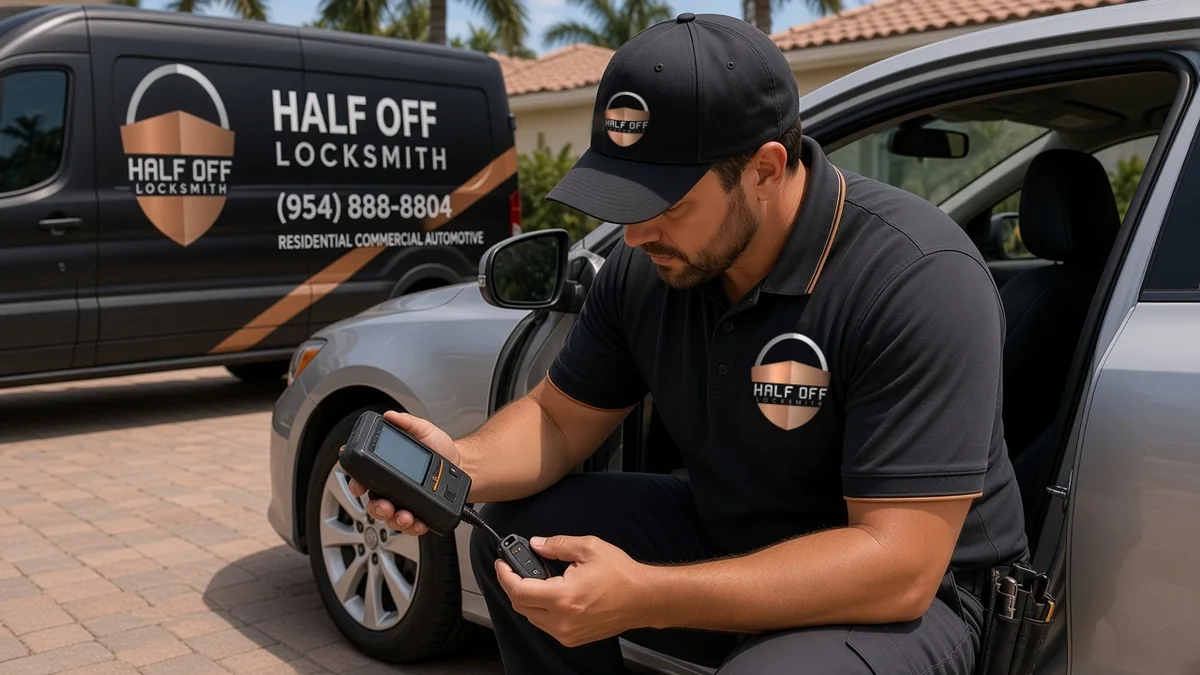
A dead car battery is a familiar South Florida inconvenience. You leave a dome light on, the car sits for a week in a Pembroke Pines driveway, or a short trip in the heat is not enough to keep the battery topped up. After a jump start or a new 12 volt battery, something feels off. A window does not work the first time. The clock is wrong. The fob seems weak. It is easy to conclude that the car "forgot" your keys and that you need them programmed again.
Most of the time, that is not what happened.
This guide separates myths from facts for everyday drivers. It explains, in general terms, where key data is stored, why a battery change usually does not erase your keys, what actually can reset, how a fob battery differs from the car battery, and when the problem really is a key. It is general guidance. Cars vary by make and year, so this is not a model-by-model manual. If your car still will not recognize a key after the battery is healthy, Half Off Locksmith can help with car key replacement in Pembroke Pines.
Where key data is stored
Modern cars do not keep your key "in the battery." The 12 volt battery in the engine bay (or, in some cars, in the trunk or under a seat) supplies power. The information that says "this chip or this fob is allowed to start this car" lives in the car's computers, often called modules.
Those modules are designed to hold that information even when the battery is disconnected. That is why you can replace a dead battery and, in the usual case, your existing keys still work. The car may act a little odd for a few minutes. The keys themselves are usually still in memory.
A few related ideas help:
The transponder or smart key is a conversation between the key and the car. The key has a chip or a wireless credential. The car has a stored list of which credentials are allowed. Programming is the process of adding or removing items on that list. A dead battery is a loss of power, not a decision to clear the list.
A very long stretch with no battery, or a battery that was removed and left off for a long time, can still leave other settings wiped. Radio presets, the clock, and some comfort settings may go back to defaults. That can look dramatic and still have nothing to do with the keys.
A failed or replaced module is a different story. If a shop replaced a body computer, an immobilizer module, or another unit that holds key data, the keys may need to be programmed to the new part. That is not the same event as a routine battery change in a driveway.
A low battery can make a good key look bad. If the car does not have enough power to listen for the fob, or to run the starter and the computers at the same time, you may see "key not detected" or a no-start even though the key is fine. This is one of the most common mix-ups after a battery has been weak for a while.
The practical takeaway: treat the 12 volt battery as the first suspect, not the key memory, when symptoms start with a no-start after the car sat or after the lights were left on.
Myth: battery change erases keys
This is the myth that causes unnecessary calls, and it is worth stating plainly.
On most cars, replacing or jumping the 12 volt battery does not erase key programming. You should not assume you need a new key, or a reprogram, just because the battery died.
Why the myth spreads:
- After a battery change, the car may need a moment to wake up. A first start can be slightly slower. A warning light may stay on for a short drive. That feels like "something was reset."
- The fob was already weak, and the stress of a dead car battery and a few extra button presses makes it obvious.
- A friend had a different problem, such as a replaced computer, and described it as "the battery killed the keys."
- Some older or unusual systems, and some aftermarket alarms, do behave badly after power is lost. Those are exceptions, and they should be diagnosed as exceptions, not used as the default story.
What to do instead of assuming the keys were erased:
- Confirm the new or recharged 12 volt battery is actually healthy and the terminals are tight and clean.
- Try the key or fob again, including the hidden emergency blade in the fob if the doors will not unlock.
- For a push button car, try the backup start method in the owner's manual, such as holding the fob against the start button or placing it in a marked pocket.
- If you have a spare key, try that too. If one key works and the other does not, the problem is more likely that key, not a wiped car.
- If no key works, and the battery is known to be good, then it is time to look at the key or the car's security system, not to replace the battery a second time.
If you already had a locksmith or a shop program a key, and everything worked until the battery died, say that when you call. It is useful history. It still does not automatically mean the programming was erased.
What can reset after a battery change (windows, clock, radio)
A battery change can reset things that are easy to mistake for a key problem. None of the items below is the same as key programming.
The clock and the radio. These often go back to a default time or lose their presets. You set them again. That is normal.
Power windows. Some cars need a simple relearn after power is lost: hold the window switch down, then up, until the auto-up function returns. The owner's manual usually describes this in a short paragraph. It is not a key procedure.
The sunroof, the moonroof or a memory seat. These can also lose a "stop" position and need a short relearn. Again, this is a comfort setting, not a key.
A security light or a warning message. Some cars show a warning until they have been driven for a short time, or until a system self-check finishes. If the car starts and runs normally, give it a little time and recheck. If a warning stays on, or the car will not start, that is a reason to look further.
Idle or driveability quirks for a few minutes. A car may idle roughly until the computers settle. If it continues, that is a mechanical or electronic issue for a mechanic, not a sign that keys were erased.
The radio anti-theft code on some older units. A few radios ask for a code after power is lost. That code is for the radio, not for the car key. It is usually in the owner's packet or available through the dealer or the manufacturer.
If the car starts with the usual key, and the only odd things are the clock, the radio, or a window that needs a relearn, you do not need a key programming visit.
Fob battery vs car battery
These two batteries get mixed up constantly, and they do completely different jobs.
The car battery is the large 12 volt battery that starts the engine and powers the car's electrical system. When it is dead, the car may not unlock with the fob, may not crank, or may crank weakly. Jump starting or replacing that battery is a car-battery job.
The fob battery is a small coin cell inside the remote or smart key. When it is weak, the buttons have short range, you have to press several times, or a push to start car says "key not detected" until you hold the fob against the start button. The engine and the 12 volt battery may be perfectly fine.
A few ways to tell them apart:
- If the metal emergency key opens the door, and the dash is completely dark, suspect the car battery.
- If the dash lights up, but the fob only works from an inch away, suspect the fob battery.
- If a jump start brings the car back to life and the fob still has poor range, the fob battery was probably already weak, and the car battery was a separate problem.
- If neither fob works and a spare that was sitting in a drawer also does nothing, think about the car (a low 12 volt battery or a module), not only about one tired coin cell.
Replacing a fob battery is often something you can do at home. Match the exact number on the old cell, and do not pry the case open with a knife. If you would rather not open it, a locksmith can do that check as part of a visit.
A fresh fob battery will not fix a dead 12 volt car battery. A new car battery will not fix a fob that has a dead coin cell, a cracked case, or water damage. Treat them as two tests, not as one mystery.
When it really is a key problem
Sometimes the key is the problem, even if a battery change is what made you notice it.
Signs it may be a key or programming issue, once the 12 volt battery is known to be good:
- One key or fob works, and the other does not, even with a fresh coin battery in the weak one.
- The car starts with the blade or with a backup method, but the remote buttons never return, even with a new fob battery.
- The car shows a message that the key is not recognized, and this continues after a confirmed good car battery and a confirmed good fob battery.
- The key was already failing before the battery died, and it is no better after.
- You lost a key, or you want a spare, and you are using the battery incident as the moment to deal with it. That is a real car key job, just not because the battery erased the memory.
- A module was replaced, or an aftermarket alarm was added, around the same time.
What is not, by itself, proof that you need programming:
- The clock is wrong.
- A window auto-up function stopped.
- The car started normally after a jump, and then everything except the clock was fine.
- The fob improved as soon as you replaced the coin battery.
If you are not sure, describe the symptoms when you call. A good technician will tell you if a battery, a jump, or a simple fob battery is the first thing to try, and will not talk you into a programming job you do not need.
If the car will not start and you have no working key at all, that is a different visit. Have your ID and registration ready, and tell us the year, make and model.
Pembroke Pines notes: heat and short trips drain batteries
Pembroke Pines driving has a few habits that are hard on the 12 volt battery, and on fob batteries too.
Short trips. A drive to a nearby plaza, a school, or a store may not give the charging system much time to replace what the starter used. A battery that is already aging can look "fine" until a slightly longer sit, or a weekend without driving, leaves it flat.
Heat. Under-hood heat in South Florida shortens battery life. A fob left in a cup holder or on a dash also has a harder life. A fob that works in the morning and fades by afternoon often needs a coin battery, not a programming session.
Cars that sit. Households with a second car, a snowbird schedule, or a vehicle that is used only on weekends see more dead 12 volt batteries than cars that are driven every day. If you have a car that sits, a battery tender (used as the manufacturer directs) can be a kinder plan than a jump every month. That is a battery habit, not a key habit.
Parking lots and garages. After a jump in a plaza lot, people often test the fob, get a weak response, and assume the keys were wiped. Try the fob battery and the emergency blade before you plan a programming visit, and make sure the jumper cables or the new battery have actually given the car a solid power supply.
When you call Half Off Locksmith at (954) 888-8804, tell us it is a Pembroke Pines car, the year, make and model, and what happened in order: the battery died, you jumped it or replaced it, and then the key or fob did this. That sequence is more useful than "I need my keys programmed."