Home | Cities | Southwest Ranches
Rekey Service in Southwest Ranches
On a property with several buildings, the question is rarely whether one lock works. It is how many keys exist and who holds them. This page is general guidance on rekeying for Southwest Ranches owners.
Call (954) 888-8804The key count nobody has
Ask most property owners how many keys exist to their house and you will get a guess, and the guess is usually low. Builders, previous owners, real estate agents, inspectors, painters, pool crews, landscapers, relatives and house sitters may each have received one at some point. Some of those copies were returned, some were copied again, and some were simply forgotten in a drawer or a truck.
On a larger property the uncertainty multiplies. The main house, a garage, a workshop, a guest cottage and a gate can all have different locks, cut for different keys, sitting on different rings. Without a deliberate effort, nobody can say who can enter which building. That uncertainty is the real reason people rekey: not because something went wrong, but because they cannot prove that nothing could.
This page is general guidance for people in Southwest Ranches. It does not describe local rules or claim any particular job. It explains what rekeying is, when it is a good fit for a spread out property and how to keep control of keys afterward.
How a rekey changes a lock
Inside a typical lock cylinder sits a row of tiny spring loaded pins, each of a specific length. The correct key lifts every pin to the exact height where the cylinder can rotate. Rekeying replaces those pins with a new set cut to a different pattern, then provides a key to match. Nothing about the outside of the lock changes. The old key can still be pushed into the lock, but it no longer lifts the pins correctly, so it no longer turns.
That is the heart of it, and it explains why rekeying is often more sensible than replacement. The handle, the deadbolt body, the finish and the installation stay as they are. Only the internal combination changes. For a house with good hardware, that makes it a clean, contained job. The article on how rekeying a lock works explains the mechanism in more detail.
What rekeying does not do is strengthen a weak door or repair a worn lock. If a lock sticks, wobbles or shows corrosion, new pins will not cure it. A technician can look at the hardware and say whether it is a good candidate for rekeying or whether replacement would serve you better.
Ask to be shown what is found when a lock is opened. Worn or bent parts, heavy corrosion or a cylinder that has been tampered with are things you should be told about plainly. A frank report builds the confidence you need to decide, and it gives you something concrete to look at instead of a bare recommendation.
Moments when rekeying makes sense
Some moments are almost universal. You have bought or inherited the property, and you do not know the key history. A contractor has finished a long job and returned your keys, but you would rather not rely on that. A tenant has moved out of a cottage. A relationship has ended and someone who used to have access should no longer. A key has been lost and may be anywhere.
Other moments are quieter. You are about to leave on a long trip and want to know that only a short list of people can enter. Or you have simply realized that your key ring weighs half a pound and you wish it were lighter. Rekeying so that several locks share one key addresses that cheerfully.
The article about how often to rekey a home suggests that there is no single schedule. The right interval depends on how many people have had keys, how often circumstances change and how comfortable you are with the unknowns. Treat changes in the household as prompts, not emergencies.
A useful rule of thumb is to ask a single question each time something changes: could someone I no longer expect to have access still be able to walk in? If the honest answer is yes, or maybe, rekeying is a calm and proportionate response. If the answer is clearly no, because the key history is short and fully known, you can leave things alone and save yourself the effort.
- You bought, inherited or moved into the property and do not know the key history.
- A contractor, caretaker, tenant or guest has finished and should no longer have access.
- A key was lost, stolen or taken after a relationship change.
- You are preparing to be away and want tight control over who can enter.
- You want fewer keys on your ring by keying several doors alike.
Rekey, replace or leave alone
The decision depends on the lock. A sound lock with an uncertain key history is a clear candidate for rekeying. A lock that is loose, corroded, damaged or too weak for the door is a candidate for replacement. A lock in good order whose keys are all accounted for may need nothing at all.
Coastal conditions count. Salt in the air and heavy humidity wear on exposed hardware, and doors facing the weather age fastest. A gritty or hard to turn cylinder may be corroded inside, and new pins will not solve that. The guide on rekey versus replace helps you sort the cases.
Cost is also part of the picture, and several factors shape it, including the number of locks, their type and the key arrangement you want. The article on what affects rekey cost explains why quotes differ. Ask for the work and the price to be explained before it begins so you can compare like with like.
One key for many doors
On a property with many entrances, keyed alike setups are a practical gift. With all the locks set to a single key, you carry one key for the house, the garage entry, the back door, the workshop and the gate. That convenience is real, and for a family it can make daily life calmer.
The trade off is that one lost key now opens everything. If that worries you, consider separating the areas: one key for the house and another for the outbuildings, or a master key arrangement in which certain keys open several doors while others open only one. The article on one key for all locks and master key systems explains how the options differ.
Compatibility matters. Not every combination of locks can be keyed alike, and mixing very different hardware limits what is possible. Tell the technician what you have, ideally with photographs of each lock, so the plan matches the hardware.
Think about growth too. If you may add a building, replace a gate or convert a room into a rental unit someday, mention it. A keying plan that leaves room for additional locks, or that can be extended without starting over, saves effort later. It costs little to plan for and is annoying to retrofit.
Outbuildings, gates and mailboxes
Secondary structures often get the weakest locks and the loosest key control. A shed lock may have been installed years ago and never changed. A gate lock may use a key that half the neighborhood once borrowed. A workshop may hold expensive tools protected by a thin hasp.
Rekeying can improve control, but it cannot fix a weak door or hasp. When you look at a shed or workshop, consider the whole assembly: lock, latch, hinges, frame and the surrounding wall. If the hardware around the lock is flimsy, a better lock helps only a little.
Do not forget the mailbox. A mailbox lock is easy to overlook, yet it holds personal documents, financial mail and packages. The article on mailbox lock replacement explains when a mailbox lock should be changed and what is involved.
Rental cottages and guest quarters deserve a note of their own. If someone lives or stays in a separate unit on your land, that unit should have its own key, ideally one that does not open your main house. Rekey between guests or tenants so that each occupant starts with a lock that only their key can open, and keep a record of when each change was made.
Restricted keys and tighter control
Ordinary keys can be copied almost anywhere. That convenience is also a weakness. Anyone with a key can duplicate it in minutes at a kiosk, and you will never know. If tight control matters, there are key systems that restrict duplication, so copies can only be cut with authorization.
Those systems add steps and cost, and they are not necessary for everyone. They suit situations where many people are involved, such as a property with staff, tenants or caretakers, or where the contents are valuable. The article on high security and restricted keys describes how they work and what trade offs to expect.
If you do not need that level of control, good habits go a long way. Keep copies to a minimum, record who holds each one, and collect keys when someone no longer needs them. A written list kept somewhere safe is simple and effective.
It also helps to separate your own keys by purpose. A tag or a short color code on each key, with the meaning recorded in your list and not on the tag itself, lets you tell the workshop key from the house key at a glance without advertising to a finder what each one opens. Keep the labels vague and the record specific.
After a break in or a scare
Sometimes rekeying follows an event. A break in, an attempted entry, a lost purse with house keys inside, or a burglary at a neighboring property can make you uneasy. The right response combines practical steps and emotional reassurance. Securing the home carefully and thoughtfully helps you feel in control again.
If someone has actually entered, the sequence matters. Contact the authorities first, avoid disturbing evidence, and photograph damage. Once the scene is released, assess the doors and frames. The checklist in after a break in: a recovery checklist covers the steps in order.
Rekeying then becomes one of several repairs. A forced door may need a new frame section or a new lock entirely, and the rekeying decision depends on the damage. Be honest with the technician about what happened, because the details change what is sensible.
Give yourself time to recover as well. After an intrusion many people want to change everything at once, and it is fine to take it in stages. Start with the doors that matter most, keep a note of what remains and come back to the rest when you feel steadier. A thoughtful plan will serve you better than a hurried, expensive overhaul done in a state of worry.
Preparing for time away
South Florida households often leave for long periods: seasonal trips, visits to family, hurricane evacuations. A home left empty is a home that depends on its locks and its key control. Before you go, think about who needs access, who should not have it, and how you will manage both while you are away.
The checklist in a vacation home security checklist offers broader advice. Within that, rekeying is one tool: it lets you start the period away with a clean slate. Hand a trusted person a key that you know is new, and keep a record of it.
During hurricane season, consider where your spare keys are, and whether anyone needs to enter the home in your absence. A plan, even a short one, avoids panicked improvisation. Also think about what happens if you must return and find the home inaccessible because a lock has failed. Humidity and a closed up house can make a lock stiff over a long absence, so test your key in each door before you leave, and ask the person watching the house to report any change in how the locks feel.
How a visit usually goes
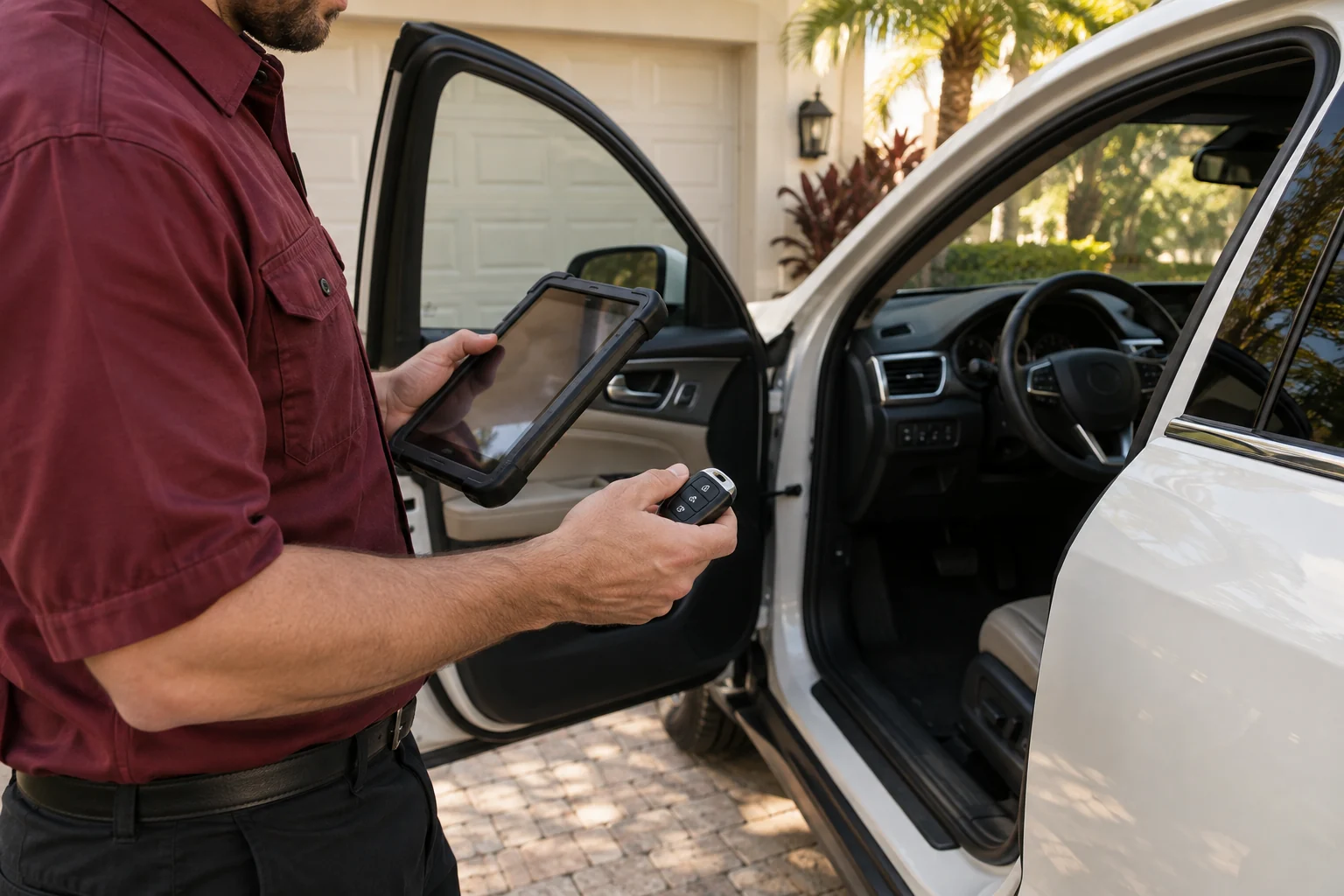
You call and describe the situation and the place, including how many locks are involved, what kinds of doors and gates they belong to and what key arrangement you want. The work and the price are explained before it begins. A technician then works through each lock, changing the pins, cutting keys and trying each one.
At the end, the finished work is tested with you. Each new key should turn its lock smoothly, and old keys should no longer work. Try them, and label the new keys right away so they do not blend into the old ring. Throw away or set aside the old keys so nobody grabs one by mistake. If you had a particular worry, such as a key that went missing, mention it to the technician before they leave so you can be sure the work addressed that exact concern.
If your property has many locks, ask about an order of work. Many people start with the main entry doors and then handle outbuildings. Others prefer to do everything at once to avoid leaving any gaps. Either approach can work, so choose what suits your schedule and comfort. If people live in the house during the work, tell them what to expect so nobody is surprised by a door that briefly cannot be locked or a key that suddenly stops working. A short conversation beforehand avoids confusion and keeps everyone patient.
Keeping control afterward
Rekeying creates a clean slate, but it does not keep it clean. Keys drift into pockets and drawers again within months unless there is a simple system. Decide who gets which key, write it down and stick to it. When someone leaves your circle of trust, collect the key and note that you did.
Half Off Locksmith serves Broward County. If you need help getting back inside before rekeying, the page on lockout service in Southwest Ranches may be more relevant. For a broader overview, see locksmith services in Southwest Ranches and the general page on house lockouts and rekeying.
Think of rekeying as maintenance, not drama. It is the same sort of task as changing a smoke detector battery or servicing an air conditioner: not exciting, but quietly protective. Done thoughtfully, it leaves you with a property where you actually know who can come and go.
Common questions
Can all the locks on my property use one key?
Often they can, if the lock types are compatible. A technician can set several locks to the same key so the house, garage entry, workshop and gate share one. Very different or old hardware may limit this. Tell them what you have, and consider whether one key opening everything suits your comfort level.
Do I need to rekey every lock I own?
Not necessarily. Many people start with exterior doors and any outbuildings where valuable items are kept. Interior locks matter less unless they protect something specific. Think about who has had access, which doors are most exposed and where a lost key would cause the most trouble.
Is rekeying better than replacing locks?
It depends on the hardware. Rekeying suits locks that are sound and only need new keys. Replacement suits locks that are worn, corroded, loose or too weak for the door. A technician can inspect the lock and tell you which is sensible, and should explain why before beginning.
What happens to my old keys?
After rekeying, old keys can still be inserted but will not turn the lock. They are harmless but can be confusing, so separate them from your new set. You may keep one as a record or dispose of them. Test that none of them work before the technician leaves.
Can I stop people from copying my keys?
Ordinary keys can be copied nearly anywhere. Restricted key systems limit duplication so copies need authorization. They add steps and cost, and they suit properties with many key holders or valuable contents. Good habits, such as few copies and a written record, are enough for many households.
Should I rekey before a long trip?
It can be a good idea if you are unsure who holds keys or if someone will be entering while you are away. Starting with fresh keys and a record of who has them gives you confidence. Also plan for emergencies, such as who can reach the house if something goes wrong.
Talk through the job before work begins
Say what went wrong and what you need to work when we leave. Scope and price are settled with you ahead of the work.
Call (954) 888-8804