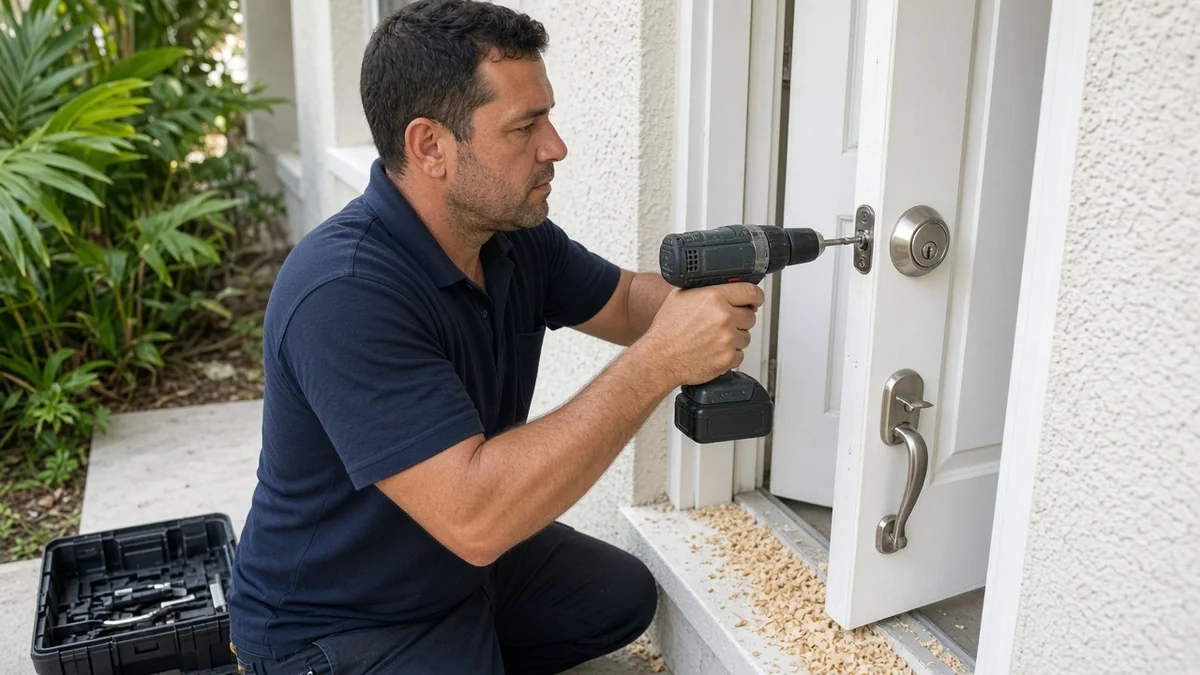
A front door can look solid and still have a weak lock. In a lot of Cooper City homes, especially houses built in the 1980s and 1990s, the original deadbolt is still on the door long after the rest of the house has been updated. The key works, most days, so nobody thinks about it until the cylinder feels loose, the bolt barely reaches the frame, or a neighbor has a scare and you start looking at your own door with new eyes.
This guide is for homeowners who are deciding whether and how to upgrade a front door deadbolt. It explains the signs that the deadbolt is the weak point, what "grades" mean in ordinary language, how to tell if a new lock will fit the holes you already have, and why the strike plate and the screws behind it matter as much as the lock in your hand. It is general guidance. It does not rank brands, name models, or talk about prices. Half Off Locksmith can look at the door with you and install a lock that fits, or rekey what you already have when a full upgrade is not needed.
If you just want a Cooper City locksmith for this kind of visit, start at our Cooper City page.
Signs your deadbolt is the weak point: short throw, loose strike, worn cylinder
A deadbolt is doing its job when the bolt throws fully into the frame, the key or thumb turn moves smoothly, and the door does not move much when you try to push or rattle it from outside. A few signs suggest it is time to upgrade, not just to spray a little lubricant and hope.
The bolt does not throw very far. Open the door, turn the thumb turn, and look at how far the bolt extends. A short, worn, or poorly fitted bolt may barely reach into the strike. If you have to lean on the door or lift the handle to get the bolt to go in, the alignment is already telling you something.
The strike plate is thin, loose, or held by short screws. Push on the locked door near the lock. If the frame moves, or if you can see short screws in a small decorative strike, the lock may be better than the wood around it. The strike is where a forced door often fails, not the cylinder.
The cylinder wiggles. If the ring around the keyhole turns, rocks, or looks oval, the lock is worn or was never tightened correctly. A loose cylinder is a poor lock, even if the key still works.
The key feels sandy, or you have a favorite "trick" to make it turn. That is wear, dirt, or a lock that is starting to fail. Forcing it can break a key in the cylinder.
The lock is a builder-grade leftover on a door you otherwise trust. Age by itself is not a reason to replace a lock that still works well. Age plus cheap hardware, a flimsy strike, and a door that has never been upgraded is a reason to look closely.
You cannot account for old keys. If the hardware is still in good shape, a rekey may be enough. If the hardware is tired, an upgrade plus a fresh key plan is cleaner than putting new keys in an old, loose cylinder.
Stand outside and look at the door as a unit: the lock, the strike, the frame, the hinges, and the gap around the door. The weak point is often a mix of two of those, not only the lock you can hold in your hand.
What grades mean in plain words (no brand rankings)
You will see locks described with a grade, sometimes on the box and sometimes in a conversation with a locksmith. In plain words, a grade is a way of talking about how much toughness and durability a lock was designed and tested for. It is not a style rating, and it is not a promise that a lock cannot be defeated.
A few useful, general points:
A higher grade, in this system, is built for harder use. That usually means stronger parts, a more solid bolt, and a design meant to hold up to more cycles and more force than a lighter lock. It does not mean the lock is "unbreakable," and it does not mean a lower grade lock is useless on a quiet interior door.
The grade only describes the lock, not the door. A sturdy deadbolt in a soft or split frame, or on a hollow door that was never meant to take a serious lock, will still disappoint. The upgrade has to include the strike and, when needed, the door or frame.
The same brand can make more than one grade. Buying by brand name alone is not the same as choosing a lock that fits a front door. This is why this article does not rank brands.
Look and grade are not the same. A handsome, heavy-looking trim can hide a light internal mechanism. Ask what you are actually getting, and ask a locksmith if the answer on the box is unclear.
Match the lock to the door's job. A front door that is the main entrance to the house is a different job than a closet. You want hardware meant for an exterior entry, with a bolt that throws fully and a strike that can be installed properly.
If you like a certain look, start with that, then confirm the lock is appropriate for a front door and will fit yours. Half Off Locksmith can help you make that call at the door, without turning the visit into a lecture about ratings. If you want the longer version of how Grade 1, 2 and 3 are tested and what the labels leave out, our deadbolt grades guide walks through it.
Fit: door thickness, backset, bore size and existing holes
The most frustrating upgrade is the one that does not fit the holes you already have, or that leaves an ugly ring of unfinished door around a smaller lock.
A few measurements decide whether a new deadbolt will sit cleanly:
Door thickness. Exterior doors are not all the same thickness. A lock made for a thinner door may not reach. A lock made for a thicker door may not tighten correctly on a thinner one. There are ways to handle some mismatches, but it is better to measure first.
Backset. This is the distance from the edge of the door to the center of the hole for the cylinder. Common residential backsets are a couple of standard sizes. If you buy the wrong one, the latch will not meet the frame where it should. Many modern latches can be set to either common size, but you should not assume that.
Bore size and spacing. A typical bored deadbolt uses a large hole through the face of the door and a smaller hole in the edge. If your door was prepped for a different size, or for a lockset that combines a handle and a deadbolt in one piece, a standard replacement may not cover the holes. Handlesets and one-piece entry sets need to be matched as a set, or the door may need a different plan.
The current holes may be worn, oval, or slightly off. Older Cooper City doors sometimes have a lock that was replaced once already, not quite in the same spot. A locksmith can often use a repair plate or a different trim to cover that. A boxed lock from a store cannot invent missing wood.
Door material matters. A solid wood door, a metal door, and a fiberglass door with a reinforced lock area all take screws and bolts differently. Some doors have a reinforcing wrap around the lock. If that wrap is bent or rusted, it should be part of the visit.
Measure twice, or have the technician measure, before anyone commits to a particular lock. Fit is not a detail. It is the whole job.
Single or double cylinder: safety and fire exit tradeoffs
A single-cylinder deadbolt is the usual household choice. It has a key on the outside and a thumb turn on the inside. You can get out by turning the thumb turn, even in the dark, without finding a key.
A double-cylinder deadbolt takes a key on both sides. People ask for it when there is glass close to the lock, because they worry someone could break the glass and turn the thumb turn. That concern is real. So is the fire-safety concern on the other side: if you need to leave in a hurry, and the key is not in the lock, you can be stuck.
A few plain guidelines:
- For most family homes, a single-cylinder deadbolt is the more sensible everyday choice, together with a good strike and a door that actually latches.
- If you are considering a double-cylinder lock because of glass, talk it through carefully. Where will the key live? Can every adult get to it in the dark? Is there another way to reduce the glass risk, such as a different lock location or a different door arrangement?
- Households with children, guests, or anyone who might have trouble with a small key should be especially cautious about a key required for exit.
- Local rules and common sense both point the same way: getting out in an emergency matters.
This is not a legal opinion, and this article will not tell you that one choice is required. It is a tradeoff you should make on purpose, not because a box on a shelf looked more serious.
Strike plate and long screws: the part that stops a kick
If you remember only one thing from this guide, remember the strike.
The deadbolt is only half of the lock. The other half is the metal plate on the frame and the wood or metal behind it. A thin strike with short screws, set into soft trim, will not support even a good bolt. A solid strike, with screws long enough to reach the framing, gives the bolt something to sit in. We cover kick resistance in more depth in our guide to strike plate upgrades; here the point is simply that a new deadbolt and an old strike are a mismatch.
When we install a deadbolt, a proper visit includes a look at:
- Whether the existing strike is loose, bent, or rusted
- Whether the hole in the frame is chewed or too shallow
- Whether longer screws can be used safely, without coming out the other side of a tight jamb
- Whether a reinforced strike makes sense on this door
You can have a high quality cylinder and still have a weak door if this part is skipped. An upgrade that only swaps the lock in the door, and leaves a tired strike in the frame, is an incomplete upgrade.
The hinges deserve a glance in the same visit. If the door has sagged, the bolt will not line up, and you will be back to leaning on the door to lock it.
Keying the new deadbolt to your other locks
A new front deadbolt that takes a different key from the side door and the garage entry is a daily annoyance, and it is usually unnecessary.
Ask to have the new deadbolt keyed alike with the other exterior locks when those locks are compatible. You can also rekey the other doors in the same visit so one key opens the set. If a door uses a completely different type of lock, the technician can tell you whether it can join the same key or should stay separate on purpose, such as a gate or a workshop.
If you are changing keys because you cannot account for old copies, keying the new deadbolt to those old keys would defeat the purpose. Start fresh, then decide how many new keys you actually need.
Label a spare and put it somewhere sensible, not under the mat and not on a tag with your address.
What a proper install visit includes
A good deadbolt upgrade is more than a few minutes with a screwdriver. You should expect something like this:
- A look at the door, the frame, the strike, the hinges, and the existing holes.
- A conversation about single or double cylinder, the look you want, and keying alike with other doors.
- A lock that fits the door, or a clear plan if the door needs a repair plate, a different prep, or hardware you did not expect.
- A careful install, with the bolt lining up and throwing fully, and with the strike secured properly.
- A test from inside and outside, with the door closed, not only with the door open.
- The number of new keys you agreed on, and a quick reminder to store a spare well.
If something about the door makes a clean install impossible in one visit, you should hear that before the old lock is in pieces on the porch.
Cooper City notes: 1980s and 1990s builder hardware
Many Cooper City neighborhoods were built in a stretch of years when a standard builder lock and a small strike were normal. Those locks have had decades of weather, a few hurried replacements, and sometimes a coat of paint they never needed. What we often see, in general terms, is not a failure by the original builder. It is hardware that has simply reached the end of a long life.
A few local patterns:
- A front door that was upgraded with a new slab, but the old strike and short screws were left in the old frame.
- A handleset that looks newer than the deadbolt above it, or the reverse, so the keys do not match and the holes do not quite line up.
- Paint in the keyway or around the latch, especially after a recent refresh.
- A side door or a garage entry that is still on the original lock, even after the front door was changed, so the "good" key only works at the front.
When you call Half Off Locksmith at (954) 888-8804, tell us it is a Cooper City front door, roughly how old the house or the door is, and what bothers you: a loose cylinder, a short bolt, a key that sticks, or simply a wish to upgrade. The more specific you are, the more likely the van has the right parts.